
Banquet Event Order (BEO) Template: Free Download, an Example and 5 Mistakes to Avoid
A banquet event order, or BEO, is the one sheet your kitchen and your event crew work from on the day. It says who the event is for, how many people are coming, what they eat, when each thing happens, and what goes on the truck.
If it is not on the BEO, it does not happen. This page gives you a free BEO template to download in Word or PDF, a filled-in example, and the five mistakes we hear about most from caterers.
Free BEO template (Word and PDF)
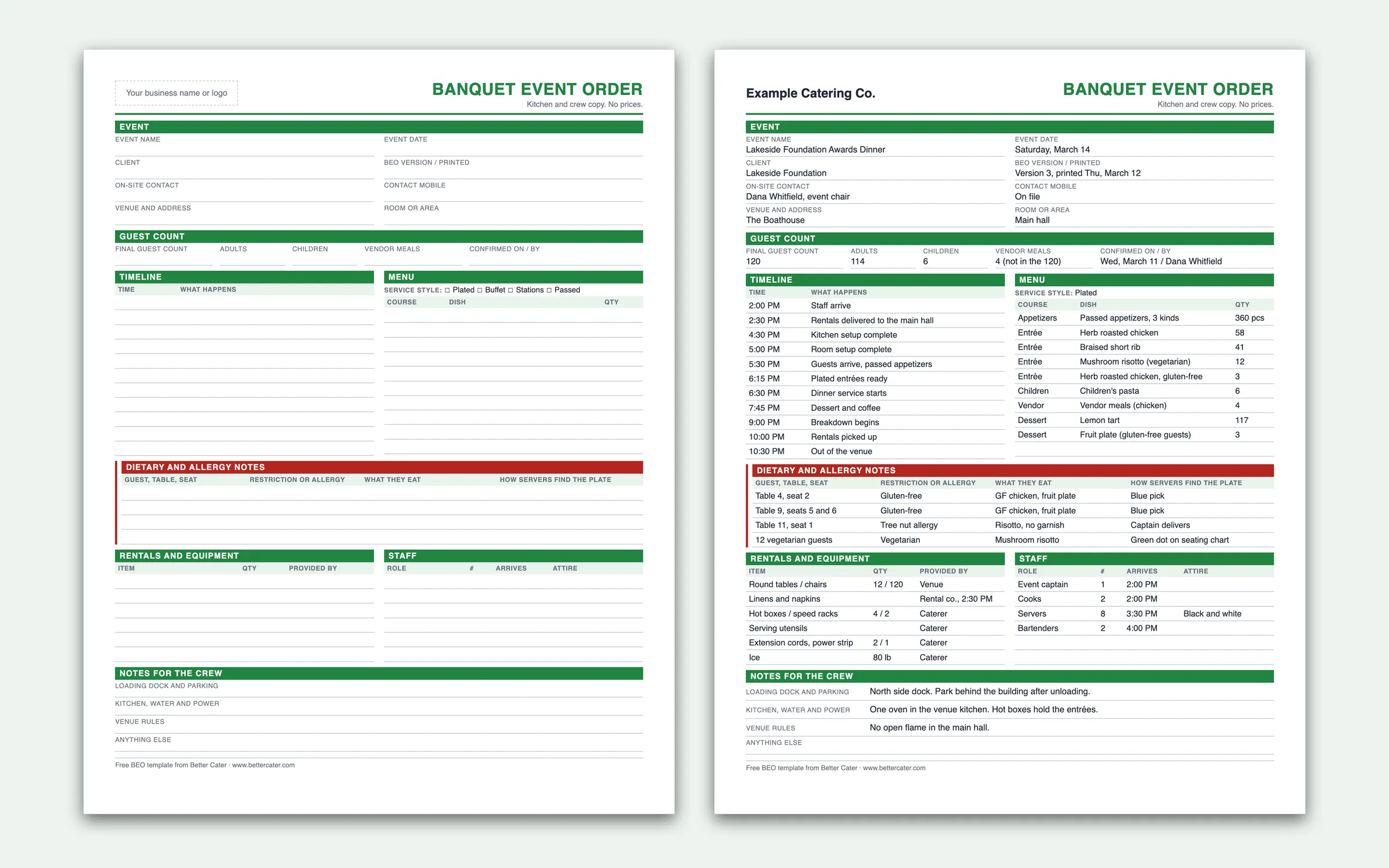
- Download the BEO template in Word (.docx), to type into and save for each event.
- Download the BEO template as a PDF, to print and fill in by hand.
- See the filled-in BEO example (PDF).
The template is free, and you do not have to give an email address. It is one page, made for the kitchen and the crew, so it has no prices on it. Put your business name or logo at the top.
What goes on a BEO
A good BEO answers every question your crew would otherwise call you about. A hotel or a banquet hall adds the room setup and the audiovisual equipment. A caterer’s BEO has these eight parts:
- Event basics. Event name, date, client, on-site contact with a mobile number, venue and address.
- Guest count. The final count, the date it was confirmed, and how it splits into adults, children and vendor meals.
- Timeline. Every time that matters, from the first staff arrival to the last piece of equipment back on the truck.
- Menu. Each dish, its quantity, and how it is served (plated, buffet, stations, passed).
- Dietary and allergy notes. Who needs what, what they are eating, and how a server finds them.
- Rentals and equipment. Every item, its quantity, and who is providing it.
- Staff. Each role, how many people, and when they arrive.
- Notes for the crew. Loading dock, parking, power, kitchen access, and anything the venue told you.
Many caterers also print a second copy with prices and the balance due, for the office and the client. The kitchen copy does not need the money on it.
Every field on the BEO template
If you want to build the BEO in your own document or spreadsheet, copy this list, fill in each line, and delete what you do not need. These are the same fields as the template above.
Banquet Event Order
- Event name:
- Event date:
- BEO version and date printed:
- Client:
- On-site contact and mobile number:
- Venue and address:
- Room or area:
Guest count
- Final guest count:
- Confirmed on (date) by (name):
- Adults:
- Children:
- Vendor meals (photographer, band, planner):
Timeline
- Staff arrive:
- Rentals delivered:
- Kitchen setup complete:
- Room setup complete:
- Guests arrive:
- Food must be ready:
- Service starts:
- Service ends:
- Breakdown begins:
- Rentals picked up:
- Out of the venue by:
Menu
- Service style (plated, buffet, stations, passed):
- Appetizers and quantities:
- Entrées and the quantity of each:
- Sides and quantities:
- Dessert and quantity:
- Beverages and bar:
- Children’s meals:
- Vendor meals:
Dietary and allergy notes
- Guest name, table and seat:
- Restriction or allergy:
- What they are eating:
- How servers will identify the plate:
Rentals and equipment
- Item, quantity, and who provides it (caterer, venue, client or rental company):
- Delivery and pickup times:
Staff
- Role, number of people, arrival time, and what they wear:
Notes for the crew
- Loading dock and parking:
- Kitchen, water and power:
- Venue rules (open flame, noise, end time):
- Anything else the crew must know:
A filled-in BEO example
Here is the same template filled in for a plated dinner. Notice that the entrées, the children’s meals and the dietary plates add up to the guest count. You can also open the example as a PDF.
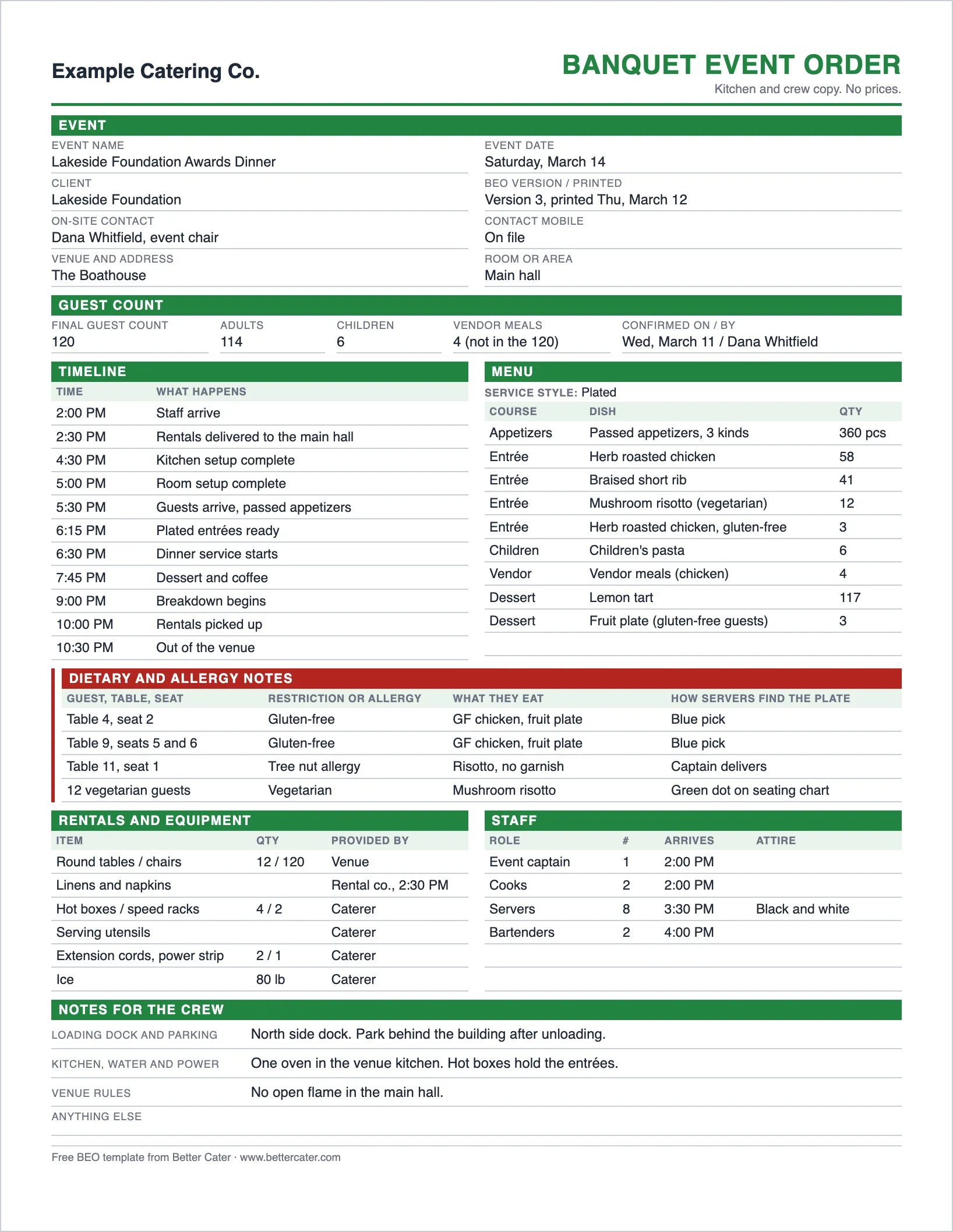
Banquet Event Order: Lakeside Foundation Awards Dinner
- Event date: Saturday, March 14
- BEO version: 3, printed Thursday, March 12
- Client: Lakeside Foundation
- On-site contact: Dana Whitfield, event chair, mobile on file
- Venue: The Boathouse, main hall
Guest count
- Final guest count: 120, confirmed Wednesday, March 11 by Dana Whitfield
- Adults: 114
- Children: 6
- Vendor meals: 4 (not included in the 120)
Timeline
- 2:00 PM: staff arrive
- 2:30 PM: rentals delivered to the main hall
- 4:30 PM: kitchen setup complete
- 5:00 PM: room setup complete
- 5:30 PM: guests arrive, passed appetizers
- 6:15 PM: plated entrées ready
- 6:30 PM: dinner service starts
- 7:45 PM: dessert and coffee
- 9:00 PM: breakdown begins
- 10:00 PM: rentals picked up
- 10:30 PM: out of the venue
Menu (plated)
- Passed appetizers: 3 kinds, 360 pieces
- Herb roasted chicken: 58
- Braised short rib: 41
- Mushroom risotto (vegetarian): 12
- Herb roasted chicken, gluten-free: 3
- Children’s pasta: 6
- Vendor meals (chicken): 4
- Lemon tart: 117
- Fruit plate (gluten-free guests): 3
Dietary and allergy notes
- Table 4, seat 2: gluten-free chicken and a fruit plate. Blue pick on the plate.
- Table 9, seats 5 and 6: gluten-free chicken and a fruit plate. Blue pick on the plate.
- Table 11, seat 1: tree nut allergy. Vegetarian risotto, no garnish. Captain delivers this plate.
- The 12 vegetarian plates are marked on the seating chart with a green dot.
Rentals and equipment
- 12 round tables and 120 chairs: venue
- Linens and napkins: rental company, delivered 2:30 PM
- 4 hot boxes, 2 speed racks, serving utensils: caterer
- 2 extension cords and a power strip: caterer
- Ice, 80 pounds: caterer
Staff
- 1 event captain, 2:00 PM
- 2 cooks, 2:00 PM
- 8 servers, 3:30 PM, black and white
- 2 bartenders, 4:00 PM
Notes for the crew
- Load in through the dock on the north side. Park behind the building after unloading.
- The venue kitchen has one oven. Hot boxes hold the entrées.
- No open flame in the main hall.
The five BEO mistakes caterers make most
These are the five problems caterers tell us about again and again.
1. Wrong or outdated guest counts
The BEO says 100 guests, but the client changed it to 115. Or the final count does not match the entrée quantities, the children’s meals or the vendor meals.
The fix: write the date the count was confirmed and who confirmed it. Then add up the plates. Entrées plus children’s meals should equal the guest count, with vendor meals listed on their own line.
2. Missing dietary restrictions
Someone notes “3 gluten-free meals” but forgets which guests need them, what they are eating, or how servers will identify them.
The fix: a dietary line is not finished until it has four things: the guest, the seat, the plate, and how the server finds it. An allergy is a safety matter, so put it where nobody can miss it, at the top of the kitchen copy as well as in its own section.
3. Incomplete event timelines
Dinner starts at 6:00 PM, but nobody specifies when staff arrive, when rentals are delivered, when food must be ready, or when breakdown begins.
The fix: start the timeline with the first staff arrival and end it with the last item off the property. If a time affects the kitchen, the truck or the venue, it belongs on the timeline.
4. Forgotten rentals and equipment
Missing serving utensils, chafing dishes, ice, linens, extension cords or hot boxes. Or nobody specifies whether the caterer, the venue or the client is providing them.
The fix: list every item with a quantity and a name beside it: caterer, venue, client or rental company. Walk through the event in your head from load-in to the last plate, and write down everything a hand touches.
5. Last-minute changes that never reach the BEO
The client changes a menu item, adds a service or adjusts the schedule. Sales knows, but the kitchen and the event team are still working from an older version.
The fix: keep one master copy, and put a version number and a print date at the top. When anything changes, print a new copy for everyone and collect the old ones.
When to send the BEO, and to whom
- About a week before the event: send a draft to the client or the planner to confirm the count, the menu and the timeline.
- When the final count is confirmed: print the kitchen copy and the crew copy.
- The day before: read it one more time against the latest messages from the client.
- After any change: new version, new print, for everyone.
The kitchen, the event captain, the truck and the venue should each have the same version.
Let your software write the BEO
A template works, but you still type every event into it by hand, and every change means typing it again.
In Better Cater, the BEO is generated from the event you already built. The event details, guest count, timeline, menu, packages, rentals and staff roles print on one branded PDF, and you can leave the prices off for the kitchen copy.
- Guest counts. Change the guest count on the event, and every per-person line moves to the new number. A line with a set amount, like 12 vegetarian plates, stays at the number you typed.
- Allergy notes. A print note goes at the top of the BEO or the kitchen report, so an allergy is the first thing the kitchen reads.
- Timeline. Add each moment to the event once, with crew instructions beside it, and it prints on the BEO and the packing list.
- Rentals and equipment. Rentals and staff roles print on the BEO, and the packing list gives the loading crew a checklist with a tick box on every row.
- Changes. The BEO always reflects the event as it stands now. When something changes, generate it again and hand out the new copy.
You can start a free trial with no credit card and build your next BEO from a real event. The steps are in our help article, Build a BEO for an event.
BEO questions
What does BEO stand for?
BEO stands for banquet event order. Some venues and caterers call it an event order or a function sheet.
What is a banquet event order used for?
A banquet event order gives everyone who works the event the same facts: the guest count, the menu and quantities, the timeline, the rentals and the staff. The kitchen cooks from it, the crew loads the truck from it, and the event captain runs the day from it.
What is the most important detail on a BEO?
The final guest count, with the date it was confirmed. Every quantity on the sheet comes from that number, so a wrong count makes the food, the rentals and the staffing wrong too. Allergy notes come next, because a mistake there is a safety matter.
Is a BEO the same as a contract?
No. The contract or signed proposal is the agreement with the client: what you will provide and what they will pay. The BEO is the working document for your own team. It comes after the booking and it changes as the details change.
Who should get a copy of the BEO?
The kitchen, the event captain, whoever loads the truck, and the venue coordinator. Many caterers also send the client a copy to confirm the details, usually with internal notes removed.
How far ahead should you finish the BEO?
Start it when the event is booked and finish it when the final guest count is confirmed, which for most caterers is 3 to 10 days before the event.